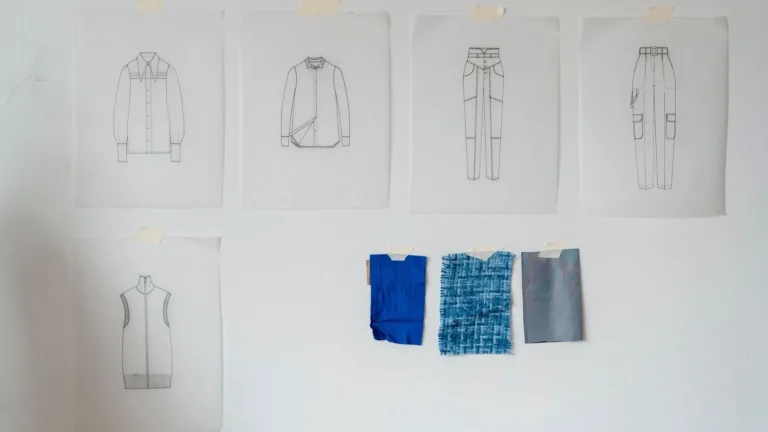
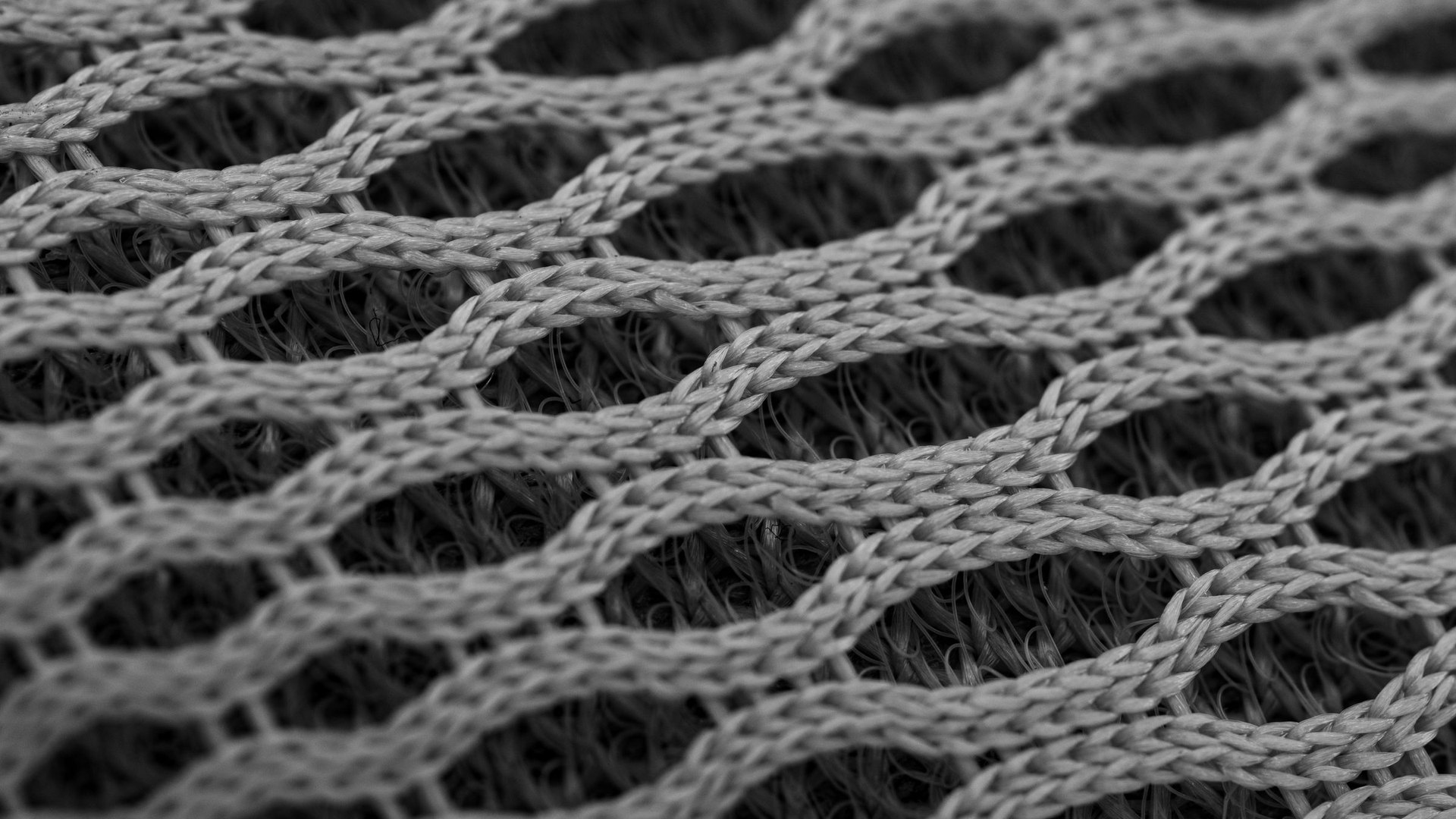
In short: GSM tells you how much one square metre of fabric weighs, and the composition tells you which fibres are in it. Neither tells you how the fabric is built. Two fabrics sold as “100% recycled polyester, 160 g/m²” or “78/22 recycled polyester/elastane” can differ in stretch, recovery, breathability, opacity, snag resistance, hand feel and print sharpness, because those depend on the knit structure, the machine gauge, the yarn and the finishing. Ask your manufacturer for those details, the test results behind them and a physical swatch before you approve a fabric for your range.
A fabric line on a spec sheet looks precise: “recycled polyester/elastane, 190 g/m²”. It is a useful start, but it describes the ingredients and the weight, not the recipe. This guide is for founders and product or sourcing managers at cycling, running, BJJ, swim and padel brands who want to compare fabrics properly and brief a manufacturer with the right questions.
What does GSM actually tell you?
GSM (grams per square metre, also written g/m²) tells you the mass of one square metre of fabric, and nothing about how that mass is arranged.
Labs measure it by weighing conditioned samples (ISO 3801 or EN 12127). Mills quote it with a tolerance, and elastane fabrics can relax after cutting, so treat it as a band, not an exact value.
What weight misses is structure. In a University of Zagreb and University of Ljubljana study, two fabrics knitted from the same filament yarn both weighed 132.5 g/m². One was 0.77 mm thick, the other 1.40 mm, and the thicker one let about 12% more air through and had about 21% lower water-vapour resistance. In the same study, a cotton piqué only 3% heavier than a plain knit let through about 47% more air. Same weight, different fabric.
Why doesn’t composition tell you enough?
Composition tells you which fibres are present, not how they are spun, knitted or finished.
A 2024 study of nine swimwear fabrics shows this well. Three of them were the same 80/20 polyamide/elastane blend, yet they weighed 172, 188 and 217 g/m² and were made from yarns of 62, 110 and 88 dtex. Same label, three different fabrics. The study also found that a fabric’s strength after long exposure to chlorinated pool water was predicted far better by its strength before exposure than by its weight.
“100% recycled polyester” is just as open: it doesn’t say whether the yarn is microfibre or standard, textured or flat, or whether the fabric is a jersey or a mesh.
How does knit structure change a fabric at the same weight?
Knit structure decides how the yarn loops are linked, and that changes stretch, recovery, breathability, opacity and snag resistance even when the weight stays the same.
There are two families. Weft knits (single jersey, interlock, rib, piqué, mesh, jacquard) are made by looping yarn across the width of the fabric, usually on circular machines. Warp knits (tricot, raschel) are made from many parallel yarns looped along the length. According to ScienceDirect’s overview of knit fabrics, warp knits are typically run-resistant, closer and flatter than weft knits, which is why warp-knitted elastane fabrics are widely used for swimwear and compression.
The table below shows typical behaviour at a similar weight. It is a guide, not a test result; always confirm on a swatch.
| Structure | Family | Stretch and recovery | Breathability | Coverage | Snags and runs | Sublimation surface |
|---|---|---|---|---|---|---|
| Single jersey | Weft | Stretches most across the width; edges curl | High: thin and open | Medium | Can ladder if a yarn breaks | Smooth face, good detail |
| Interlock | Weft (double knit) | Stable, lies flat | Lower: thicker | High | Better than single jersey | Smooth on both sides, fine detail |
| Rib | Weft (double knit) | Highest stretch across the width | Lower | High | Better than single jersey | Ribs show through the print |
| Piqué and other tuck textures | Weft | Tucks add width and texture | High porosity | Medium | Check on a swatch | Texture softens fine lines |
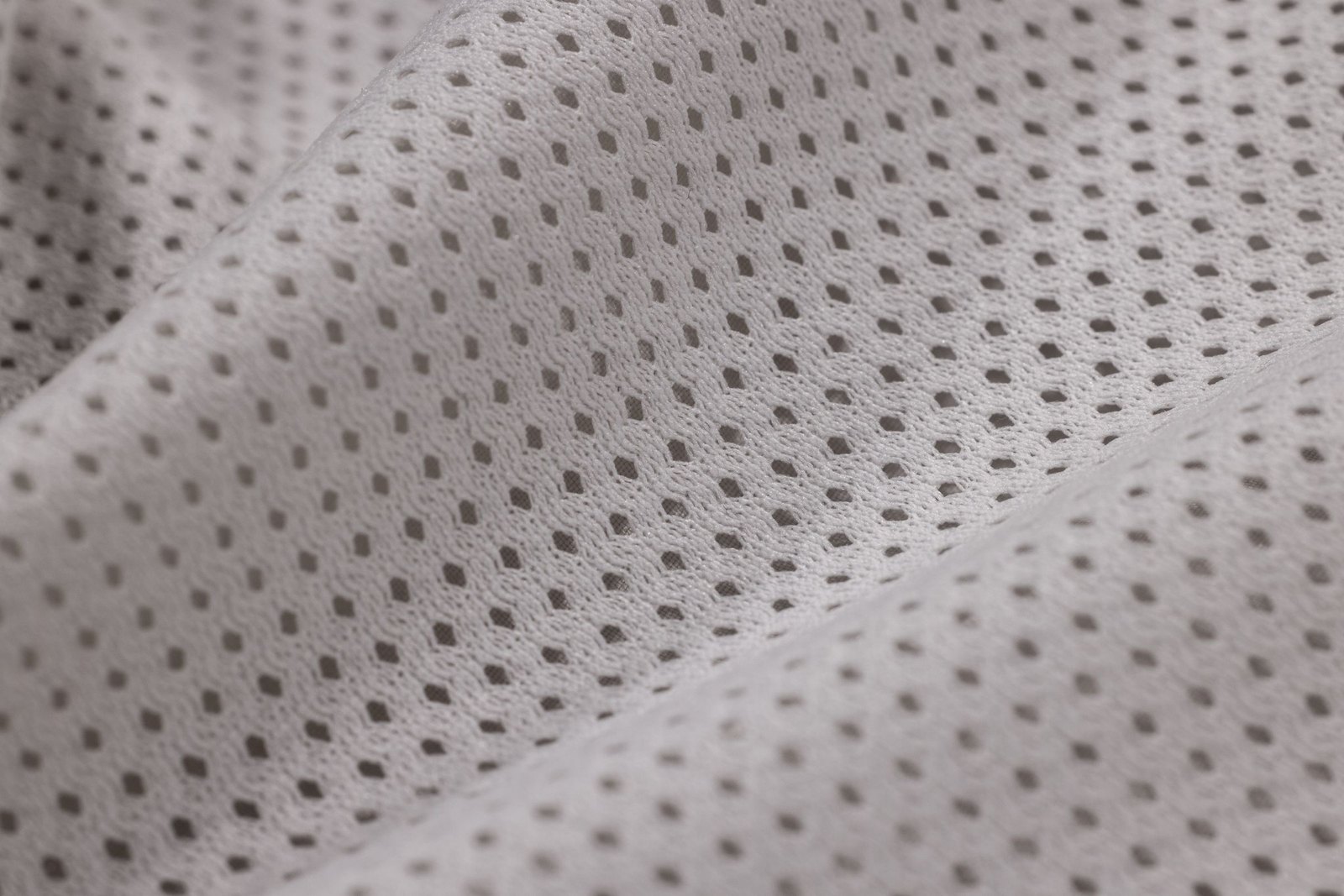
| Mesh or eyelet | Weft or warp | Depends on the base knit | Very high | Low: can show through | Open holes can catch | Holes break up fine lines and small text |
| Tricot with elastane | Warp | Strong, controlled stretch with good recovery | Lower to moderate: close structure | High | Run-resistant | Very smooth, flat face |
| Spacer | Warp or weft (3D) | Low stretch, cushioned | High through the open middle layer | High | Depends on the outer face | Prints on the outer face |
Sources: Textile School, Zagreb/Ljubljana study, ScienceDirect.
What does machine gauge mean, and is a higher gauge better?
Gauge is the number of needles per inch on the knitting machine, and a higher gauge gives finer loops and a smoother face, not automatically a better fabric.
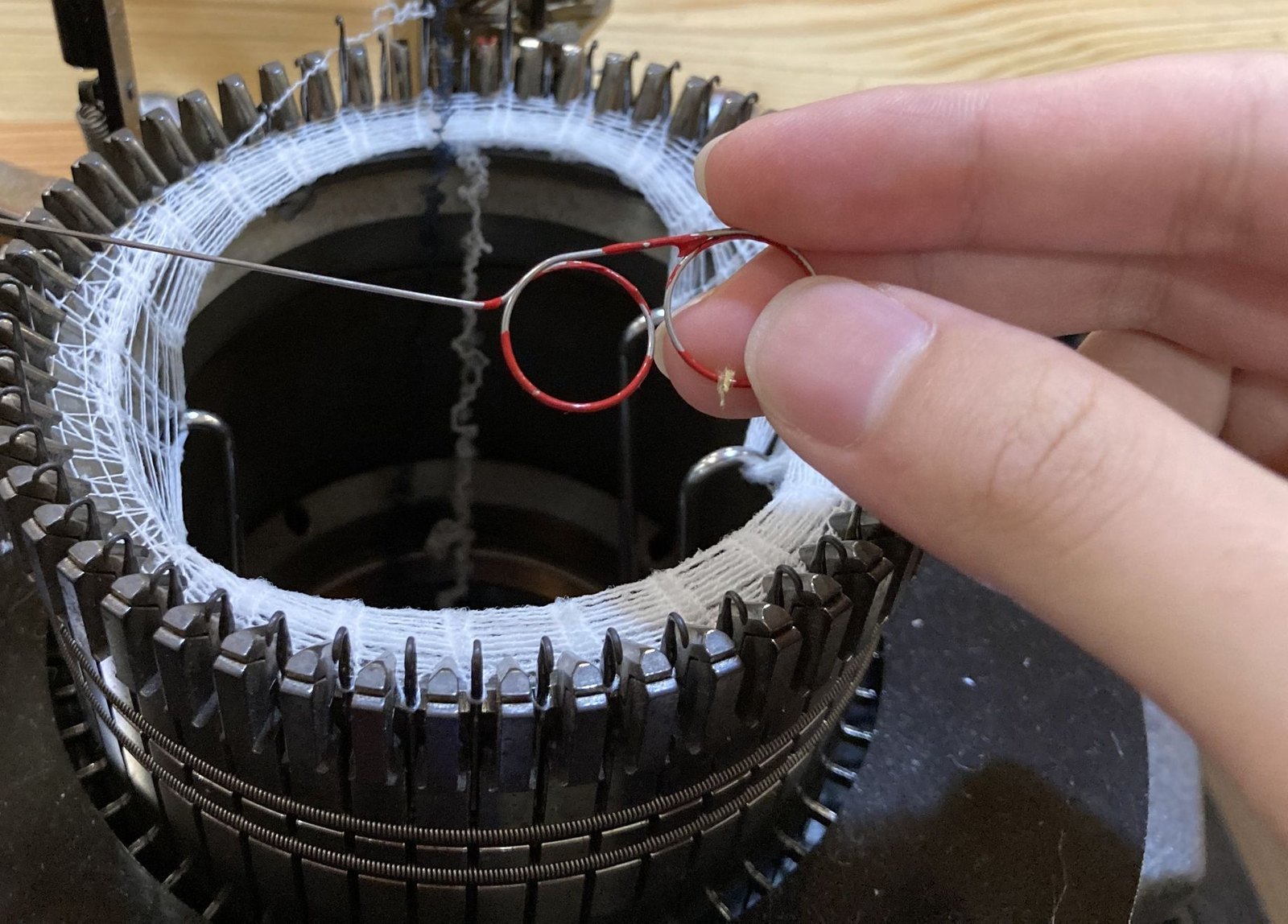
An E28 machine has 28 needles per inch; an E32 or E40 machine has more, closer together. Finer gauges need finer yarn, so gauge and yarn are always chosen together. Jersey fabrics are typically knitted on 18 to 32 gauge machines, and machine maker Mayer & Cie builds its elastane-plating single-jersey machine for sportswear in gauges from E18 to E32.
Gauge is a machine setting, not a fabric measurement. The same gauge with longer loops gives a lighter, more open fabric; relaxation and finishing then change the final stitch density.
For sublimation, a finer, denser surface usually gives the transfer paper more continuous contact, so fine lines and small text print more cleanly. Treat that as a rule of thumb and check it on a printed strike-off with your own artwork.
Which yarn details matter most?
The yarn’s fineness, filament count, texture and cross-section shape affect hand feel, wicking and pilling as much as the fibre type does.
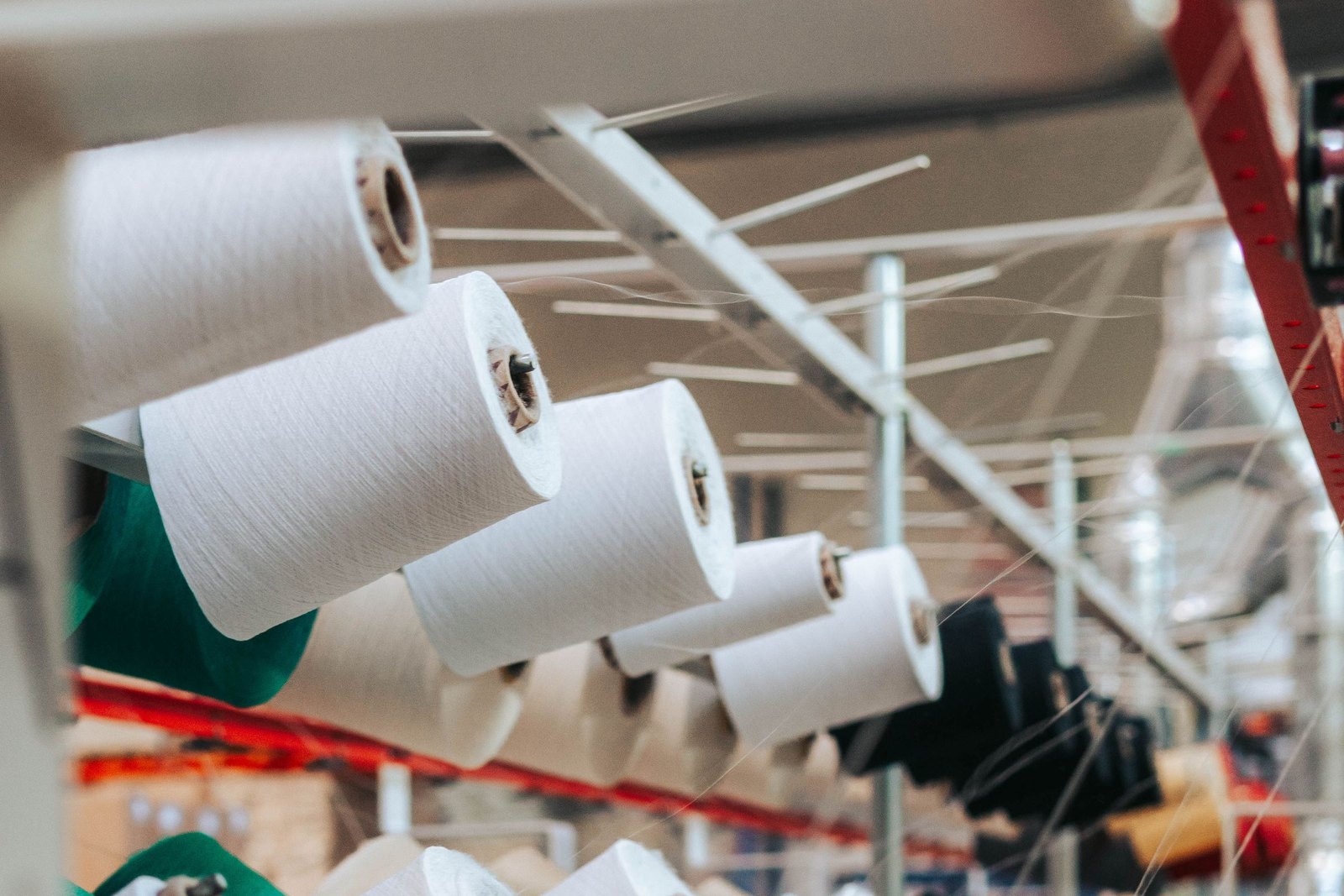
- Fineness (dtex or denier). Finer yarn allows lighter, smoother fabrics at a higher gauge.
- Filament count. Divide the yarn’s denier by its filament count to get denier per filament. Below roughly 1, the yarn counts as microfibre, which feels softer. One study found microdenier polyester fabrics gave faster sweat evaporation and a cooler feel at first touch.
- Filament or spun. Continuous filament is smooth; spun yarn has more protruding fibre ends. In the Zagreb study, yarn hairiness strongly affected air permeability.
- Textured (DTY) or flat (FDY). Textured yarn is crimped for bulk, softness and some stretch; flat yarn is smoother with more lustre.
- Cross-section. Fibres with channelled cross-sections, such as COOLMAX, move moisture along the fibre surface, and the effect is built into the fibre rather than added as a finish.
Does recycled polyester perform the same as virgin polyester?
Recycled polyester is the same polymer as virgin polyester, but its performance depends on the feedstock, the recycling process and the yarn, so test the fabric rather than assume either way.
According to Textile Exchange’s Materials Market Report 2025, recycled polyester made up about 12% of polyester fibre in 2024. Nearly all of it was made from PET bottles; textile-to-textile recycling accounted for only about 2% of recycled polyester.
Research on performance is mixed. A 2026 fibre study found recycled PET staple fibres were chemically identical to virgin ones but about 26% weaker, with rougher surfaces. A 2023 ageing study found recycled polyester knits lost more mass in abrasion testing, although the fabrics compared were not identical in weight or elastane content. Other studies report the opposite for some fibres. So judge the finished fabric by its test results.
The Global Recycled Standard (GRS) verifies recycled content and chain of custody; it is not a performance test. All Sportswear of Tomorrow fabrics are GRS certified. Under Directive (EU) 2024/825, which applies from 27 September 2026, a specific claim such as “78% recycled polyester, GRS-certified fabric” is much safer on your product pages than a generic environmental one.
Why doesn’t the elastane percentage tell the whole story?
The elastane percentage tells you how much stretch fibre is present, not how it is built into the fabric, and construction decides most of the stretch and recovery.
What to look at beyond the percentage:
- Elastane dtex. Ask for it alongside the percentage; it is part of how the stretch is engineered.
- Bare or covered. Bare elastane is knitted in alongside the main yarn; covered or core-spun elastane is wrapped in another fibre first, which changes how the fabric is processed and finished.
- How it is knitted in. In circular knits, elastane is often plated into every course or every second course. In warp knits it runs as its own set of yarns. The same 20% can behave very differently.
- Heat setting. Circular knits with bare elastane are usually heat-set to fix their width, weight and stretch. That means the final GSM is partly a result of finishing, not just knitting.
- Chlorine. Elastane is a polyurethane and is attacked by chlorine. For swimwear, ask whether a chlorine-resistant elastane is used and for colourfastness to pool water (ISO 105-E03).
Our rashguards show why the full specification matters. They are made from Italian Carvico Vita PL: 78% recycled polyester and 22% elastane, 190 g/m², OEKO-TEX certified and UPF 50+. Carvico specialises in warp-knitted stretch fabrics for swimwear and sportswear, and lists shape retention among Vita PL’s features. The 78/22 split alone would tell you neither.
How does finishing change hand feel and print?
Finishing can change a fabric’s hand feel, stability and even its final weight after knitting, so two fabrics from the same machine can still behave differently.
- Heat setting stabilises width and reduces shrinkage; too much heat can stiffen the fabric.
- Brushing or peaching raises fibres for a softer, warmer touch, but can increase pilling.
- Calendering presses the fabric flatter and smoother, changing how it handles moisture.
- Wicking and antimicrobial finishes are chemical treatments. Ask how many washes they are tested to; in the 2024 swimwear study, a water-repellent treatment wore off with use.
Ask whether the fabric is prepared for sublimation, and print a strike-off before you approve it.
Why does structure affect sublimation print and colour?
Sublimation dye bonds with polyester fibres, so a print can only be as sharp and even as the polyester surface it lands on.
In sublimation, disperse dyes turn into a gas at around 180–200 °C and enter the polyester fibre, as explained in Roland DG’s dye-sublimation guide. That is why sublimated sportswear is made from polyester-rich fabrics: cotton does not take the dye without a coating.
Smooth, closed knits hold fine lines and small text best. Open mesh loses detail where the holes are, and textured piqué softens edges. Colour also shifts between fabrics: we work from your Pantone references, but slight colour differences can occur because sublimation ink absorbs into the fabric. Approve colour on a printed sample in the actual fabric.
What should you ask your manufacturer instead of GSM and composition?
Ask for the full construction, the test results and a physical swatch, not just a weight and a fibre list.
Questions to ask your manufacturer:
- Knit type: weft or warp, and which structure (jersey, interlock, mesh, tricot)?
- Gauge: what machine gauge, and the stitch density if known?
- Yarn: dtex, filament count, textured or flat, any special cross-section?
- Recycled content: what percentage, what feedstock (bottle or textile), and a valid GRS certificate?
- Elastane: percentage, dtex, bare or covered, how it is knitted in, chlorine-resistant for swim?
- Finishing: heat-set, brushed, calendered, wicking or antimicrobial finish, and how durable?
- Weight and width: with tolerances?
- Stretch and recovery: in both directions, to EN ISO 20932-1?
- Breathability and wicking: air permeability (ISO 9237) and wicking (AATCC TM197 or TM195)?
- Pilling and abrasion: Martindale (ISO 12945-2) or pilling box (ISO 12945-1)?
- Colourfastness: washing, perspiration, rubbing, light and, for swim, chlorinated water (ISO 105 series)?
- Shrinkage: after washing (ISO 5077 with ISO 6330)?
- Opacity and UPF: see-through when stretched? UPF tested to EN 13758-1 or AS/NZS 4399?
- Certificates: GRS and OEKO-TEX STANDARD 100, with scope and expiry date?
- Physical proof: a swatch, a printed strike-off with your artwork and a sample garment?
How Sportswear of Tomorrow approaches fabric
Sportswear of Tomorrow at a glance
- Custom sublimated sportswear manufacturer since 2002
- Own factory in Aiud, Romania: printing, cutting and sewing in-house
- All fabrics GRS certified
- Jerseys and shorts in 100% recycled polyester or recycled polyester/elastane blends, depending on the style
- Rashguards in Italian Carvico Vita PL: 78% recycled polyester / 22% elastane, 190 g/m², OEKO-TEX certified, UPF 50+
- From 1 piece; 2.5–4 weeks from artwork approval
Fabric weight varies by product, and the final choice depends on the garment and how it will be used. We make private-label sportswear for cycling, running, fight, swim and padel brands, including custom road cycling kit, running apparel and custom rashguards. If you want your own style, see how to develop your own sportswear.
Get a quote
Tell us which garments you plan, how they will be used, rough quantities and your launch date. We’ll come back with questions and a quote, and the first step for a new style is always a sample you can feel and test.
Sources
- Salopek Čubrić et al. (2022), “Material and Structural Functionalization of Knitted Fabrics for Sportswear”, Materials: pmc.ncbi.nlm.nih.gov/articles/PMC9104909
- Potočić Matković et al. (2024), “The Impact of Chlorinated Water and Sun Exposure on the Durability and Performance of Swimwear Materials”, Polymers: doi.org/10.3390/polym16213050
- Katić Križmančić et al. (2023), “Changes in Mechanical Properties of Fabrics Made of Standard and Recycled Polyester Yarns Due to Aging”, Polymers: doi.org/10.3390/polym15234511
- Abera et al. (2026), “Comparative Study of Virgin Polyester and Recycled Polyester Fiber Properties”, Journal of Fiber Science and Technology: jstage.jst.go.jp
- Textile Exchange, Materials Market Report 2025 and Global Recycled Standard
- CottonWorks: knit machinery and gauge; Mayer & Cie Relanit 3.2 HS II
- Carvico Vita PL; Roland DG dye-sublimation guide
- Directive (EU) 2024/825
Frequently asked questions
What does GSM mean for sportswear fabric?
GSM means grams per square metre: the weight of one square metre of fabric. It is useful for comparing fabrics of the same construction, but it does not describe the knit structure, gauge, yarn or finishing, which decide stretch, breathability and feel.
Is a higher GSM fabric better quality?
Not necessarily. A heavier fabric may be thicker or more opaque, but weight alone doesn’t predict performance. In one swimwear study, a fabric’s strength after long chlorine exposure was predicted far better by its strength before exposure than by its weight.
What is the difference between warp-knit and weft-knit fabric?
Weft knits, such as single jersey, interlock and mesh, loop yarn across the width of the fabric. Warp knits, such as tricot, loop many parallel yarns along its length. Warp knits are typically closer, flatter and run-resistant, which suits swimwear and compression.
Does recycled polyester perform as well as virgin polyester?
It is the same polymer, but performance depends on the feedstock, the recycling process and the yarn. Studies show mixed results, so judge each fabric on its test results, not on whether it is recycled or virgin.
What does 78/22 polyester/elastane mean?
It means 78% polyester and 22% elastane by weight. It tells you how much stretch fibre is present, not how it is knitted in. Elastane dtex, bare or covered yarn, the knit construction and heat setting decide how the fabric stretches and recovers.
Which fabric tests should I ask a supplier for?
Ask for stretch and recovery (EN ISO 20932-1), air permeability (ISO 9237), wicking (AATCC TM197 or TM195), pilling (ISO 12945), colourfastness (ISO 105 series), shrinkage (ISO 5077) and, where relevant, UPF (EN 13758-1 or AS/NZS 4399), plus GRS and OEKO-TEX certificates and a physical swatch.